
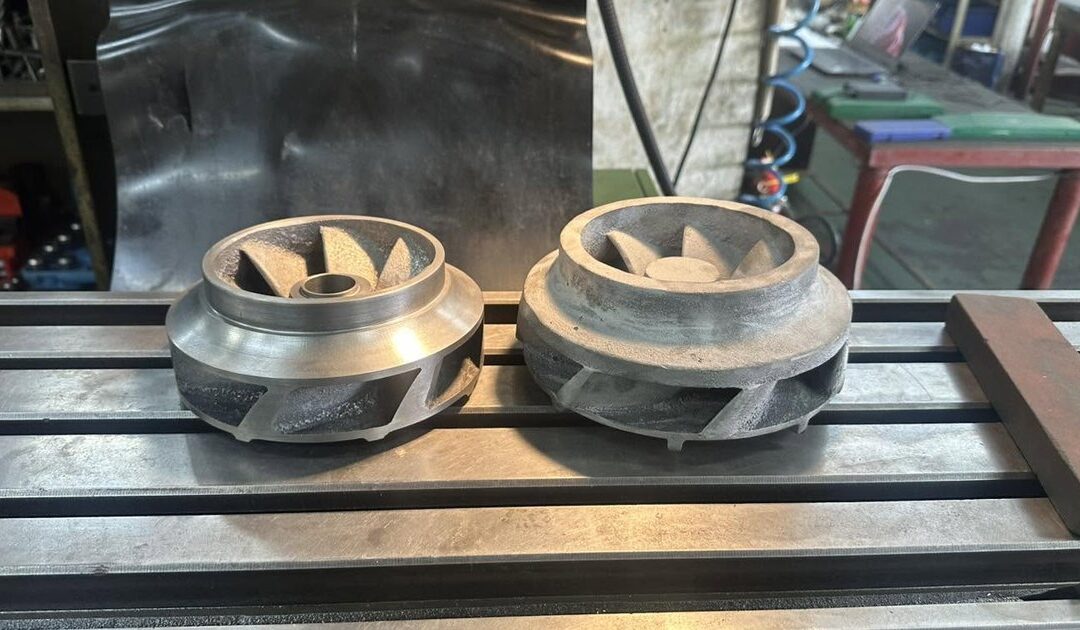
Every week someone phones us with a version of the same story. A vintage tractor that’s been in the family for fifty years. A fishing boat with an engine nobody’s imported since the eighties. A generator keeping a farm running. A stationary engine in a mill. And always the same sentence: “The part doesn’t exist anymore. Everyone says the machine is finished.”
Usually, it isn’t. Here’s how a component nobody makes can be made again — and how we do it in Durban.
Why good machines die: the parts problem
Machines rarely die of old age — they die of parts unavailability. The OEM discontinued the model decades ago. The tooling was scrapped. The local importer closed in 1994. The overseas supplier that still lists the part wants more for shipping than the machine is worth, with a four-month lead time — if the part ever arrives at all.
The traditional options are grim: scavenge scrapyards for another worn example of the same part, gamble on that overseas order, or scrap equipment that’s otherwise perfectly sound.
There’s a fourth option: make the part again.
How reverse engineering works, step by step
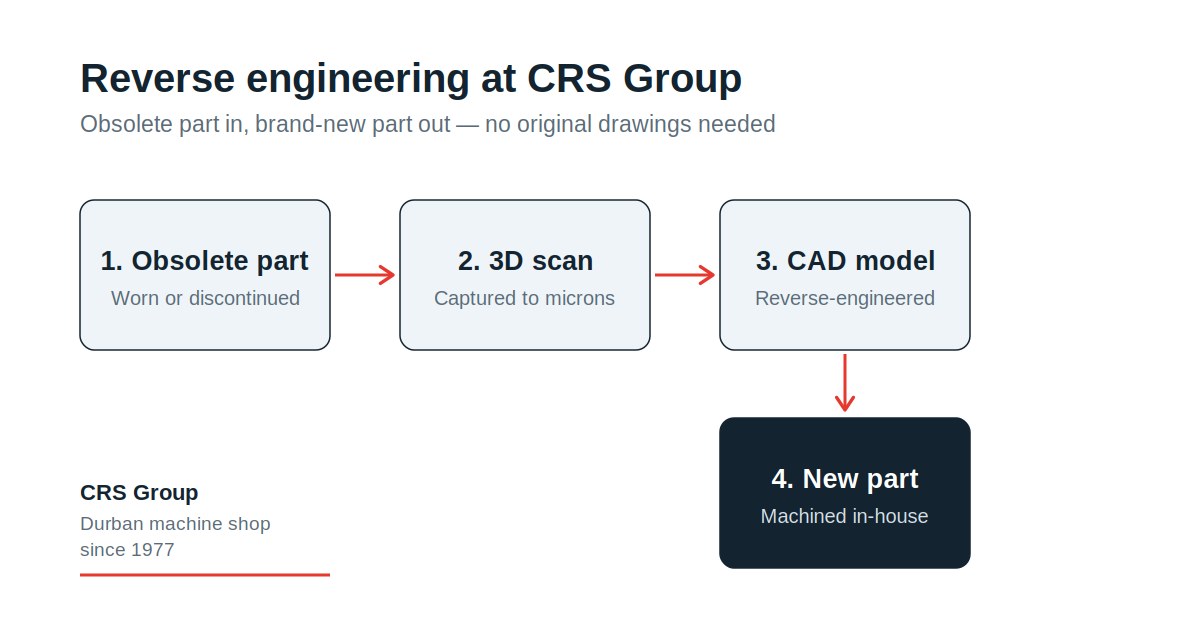
- Start with your sample — the worn, damaged or even broken original. It carries nearly all the information we need. (Keep every fragment. Never throw the pieces away.)
- 3D scanning — the component is scanned, capturing its complete geometry in fine detail, far beyond what hand measurement alone can do.
- CAD reconstruction — the scan becomes an engineering model. This is where skill matters: we correct the model back to design dimensions, not worn ones — a journal that measures undersize from wear gets modelled at its proper size; missing geometry on a broken part is reconstructed from mating components or the engine’s other bank.
- Material selection — the right steel or iron specification for the job the part does. A conrod is not made from “whatever’s on the rack.”
- Manufacture — machined in-house in our own shop, then finished: bearing surfaces, bores and threads to specification.
- Verification — the finished component is measured and checked against the model before it goes anywhere near your engine.
Because the CAD model is kept, the second part is easier than the first. Fleets running old equipment sometimes have us make a spare at the same time — the marginal cost of part two is much lower, and the machine never stands again for that component.
What we can make
- Conrods — our most requested remanufacture; see our conrod services
- Crankshafts — for engines where no exchange shaft has existed in decades; see crankshaft services
- Camshafts
- Bushes, sleeves, pins and shafts — the small parts that stop big machines
- Housings, covers and brackets — machined from solid or repaired-and-machined
- General components to sample or drawing — if it’s machineable, ask
And it combines with everything else under our roof: a vintage engine might get its cracked block metal stitched, its bores resleeved to standard, its crank journals rebuilt — and its unobtainable conrod manufactured new. That combination — repair plus remanufacture in one shop — is what brings engines back that everyone else has given up on.
WhatsApp us photos of the part (broken is fine) and the machine details — we’ll tell you honestly if it can be made, and what it would cost.
Who this is for
| Who | Typical job |
|---|---|
| Vintage & classic owners | Conrods, pistons-era components, shafts for engines from the 1930s–1980s |
| Marine operators | Components for engines whose importers vanished decades ago — while the boat still earns |
| Farmers | Tractors, pumps and gensets that owe nobody anything except one part |
| Industrial & mining plant | Obsolete equipment where replacement machines cost millions — and one component is the difference |
| Workshops & restorers | The part their customer’s project can’t move without |
The honest part: when manufacture isn’t the answer
One-off manufacture is engineering, not retail — it costs more than a mass-produced spare ever did. So we’ll tell you straight when it doesn’t make sense: if your engine is a common model with parts still on shelves, buy the part. If the machine’s total condition doesn’t justify the investment, we’ll say that too.
But when the equipment matters — commercially, practically or personally — and the part genuinely doesn’t exist, this is the difference between a dead machine and a running one. That call is yours; our job is to give you a real number so you can make it.
Frequently asked questions
Can you make a part that’s no longer manufactured?
Can you work from a broken part?
Is the new part as strong as the original?
What does it cost?
WhatsApp us a photo of the worn or broken component and the machine it came from — we’ll tell you whether we can scan, reverse-engineer and remake it, and roughly what it takes.