
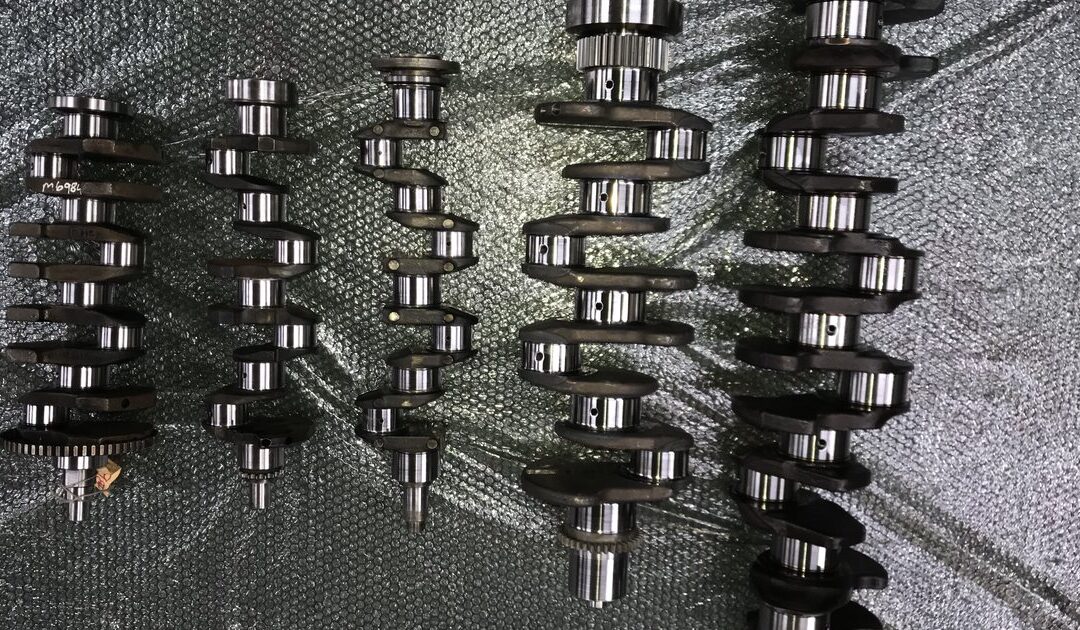
It usually starts the same way: a knock from the bottom end, oil pressure that won’t come up, or copper showing on a bearing shell at teardown. Then comes the question every workshop and owner has to answer — is this crankshaft worth saving, or does it need replacing?
After 45+ years of grinding crankshafts in Durban, our honest answer is: most worn crankshafts can — and should — be reground. But not all of them. Here’s how we make the call in our workshop, so you can make an informed decision before spending money in the wrong place.
The warning signs your crankshaft needs attention
- Bearing knock — a deep, rhythmic knock from the bottom of the engine, worst under load
- Low or slow-building oil pressure — worn journals open up bearing clearances, and pressure bleeds away
- Visible scoring on the journals — ridges or grooves you can feel with a fingernail
- Copper showing on bearing shells — the bearing surface has worn through; the journal has been running on the backing
- Metal flakes in the oil or filter — bearing material breaking up and circulating
If you’ve had a spun or failed bearing, never just fit new shells and reassemble. The journal is almost certainly damaged or undersized, and the new bearings will fail the same way — usually within weeks. Measure first, always.
What crankshaft grinding actually does
Crankshaft grinding (also called regrinding) machines each worn journal down to the next factory-specified undersize — usually in 0.25 mm steps. Matching undersize bearings are then fitted, restoring the exact clearances the engine left the factory with.
Done properly, the process looks like this:
- Crack testing — the shaft goes through magnetic crack detection first. There’s no point machining a cracked crank, and no honest shop skips this step.
- Measurement and runout check — every journal is measured and the shaft is checked for bend between centres.
- Grinding — journals are machined to the next undersize, concentric and parallel.
- Polishing — the journals are polished to the correct surface finish. This step matters more than most people realise: too rough and it wears the new bearings; the finish controls the oil film that keeps the crank alive.
- Final inspection — dimensions verified, and the shaft goes back with its undersize marked so the right bearings get ordered.
A properly reground and polished crankshaft, fitted with the correct undersize bearings, performs to factory specification. It is not a compromise — it’s how engines have been rebuilt for a century.
Regrind vs replace: the real comparison
| Regrind at CRS | New / imported crankshaft | |
|---|---|---|
| Cost | A small fraction of a new shaft — often the difference between a repair bill and writing off the engine | Frequently the single most expensive part in a rebuild; imported shafts attract freight and exchange-rate pain |
| Availability | Your shaft, back in days | Common engines: days. Trucks, plant, marine and older engines: weeks to months on a ship — if available at all |
| Quality | Original factory forging, machined back to spec and crack tested | OEM: excellent. Cheap aftermarket/pattern shafts: quality varies widely |
| Downtime | Short — the engine goes back together on your schedule | Your truck, bakkie, boat or machine stands until the part lands |
For fleets, plant operators and anyone whose equipment earns money, that downtime line is usually the deciding factor — a standing truck costs more per week than the entire regrind.
WhatsApp us a photo of the journals and the engine make — we’ll tell you straight, usually the same day.
When regrinding alone isn’t enough — and the crank still isn’t scrap
Some crankshafts arrive at our shop after being condemned elsewhere: a journal too deeply scored to clean up at the final undersize, damage from a spun bearing, or a bend from a hard failure. At most machine shops, that’s the end of the road.
At CRS it usually isn’t, because we combine the machine shop with specialist welding and engineering under one roof:
- Journal build-up welding — the damaged journal is built up with weld, then reground to size. The shaft comes back to specification instead of going in the scrap bin.
- Straightening — bent shafts are corrected between centres before grinding.
- Full remanufacture — for obsolete engines where no replacement exists, we can 3D-scan your shaft, reverse-engineer it and manufacture a new one — a service almost nobody else in KZN offers.
Get a second opinion before you buy a new shaft or scrap the engine. It costs nothing to ask, and we save shafts other shops condemn every month.
When we’ll tell you to replace it
An honest shop also knows when to say no. We’ll recommend replacement when:
- Crack testing finds cracks in a critical area — no regrind fixes a cracked crank, and we won’t machine one
- The shaft is at its final undersize and the damage is beyond economical weld repair
- A new shaft for that engine is genuinely cheap and available — sometimes the maths simply favours new, and we’ll say so
That honesty is why workshops across KZN send us their measuring work: a wrong call costs you an engine, and it costs us a customer. Neither of us wants that.
While the crank is out — check the rest
A crankshaft rarely wears alone. If the bottom end is apart anyway, it’s cheap insurance to have the related components checked at the same time:
- Conrods measured and resized — a spun bearing usually ovals the big-end housing
- Block checked — main tunnel alignment (line boring) and bore condition
- Cylinder head tested and skimmed — especially after any overheating
Frequently asked questions
How many times can a crankshaft be reground?
Is a reground crankshaft as good as new?
What does crankshaft grinding cost?
Can a deeply scored or damaged journal be saved?
Call or WhatsApp the engine make and model — we’ll tell you whether to grind, rebuild or replace, and quote it fast.